

 Placeholder image. FPO
Wake County · North Carolina
Cary
Cary is the most deliberately regulated town in the Triangle, and almost everything people like and dislike about it traces back to the same set of ordinances.
You can read Cary's rulebook off its streets. The absence of billboards, the width of the buffers, the fact that the shopping center is set back behind trees rather than parking — none of that is taste. It is code.
Whether that produces the best town in the Triangle or the least surprising one is the argument every buyer here eventually has with themselves.
What kind of place is Cary, actually?
A town of roughly 180,000 people that governs itself like a much smaller one. Cary has unusually strict standards for tree preservation, signage, building materials and buffering, and has applied them consistently for decades — which is why it reads as green, quiet and orderly, and also why it can feel uniform.
The practical consequence for a buyer is that quality is high and variance is low. It is genuinely difficult to buy a badly built or badly sited house in Cary. It is also difficult to buy an unusual one.
People who move here from denser cities tend to describe the same adjustment: everything works, and nothing is accidental. Whether that is restful or airless is a matter of temperament, and it is worth being honest with yourself about which you are before you commit.
The comparison most buyers here actually weigh is Morrisville, next door.
Cary is four towns wearing one name
The submarkets do not blend into each other. Knowing which one you are in explains more than any town-wide figure.
- 01
West Cary
Everything roughly west of Davis Drive out to the Chatham County line — Carpenter, Highcroft, Amberly, Green Level. Overwhelmingly built after 2000, larger houses on larger lots, and the shortest drive to Research Triangle Park via Davis Drive or NC-540. Read the study
- 02
The golf belt
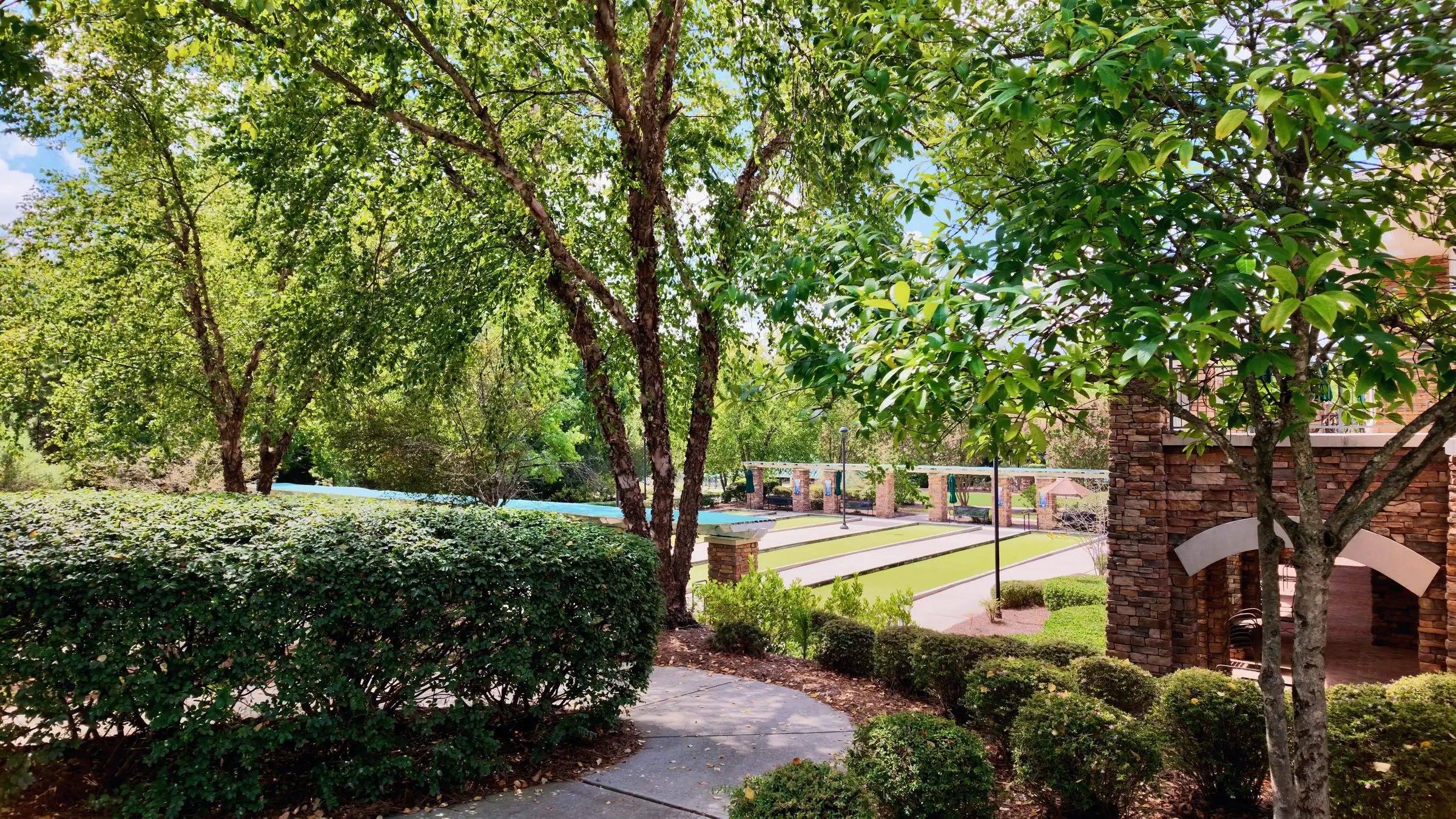
Preston, MacGregor Downs, Lochmere. Master-planned communities from the late 1970s through the 1990s, built around country clubs and lakes, with mature landscaping that newer parts of town will not have for another thirty years. Read the Preston study
- 03
Downtown and the old grid
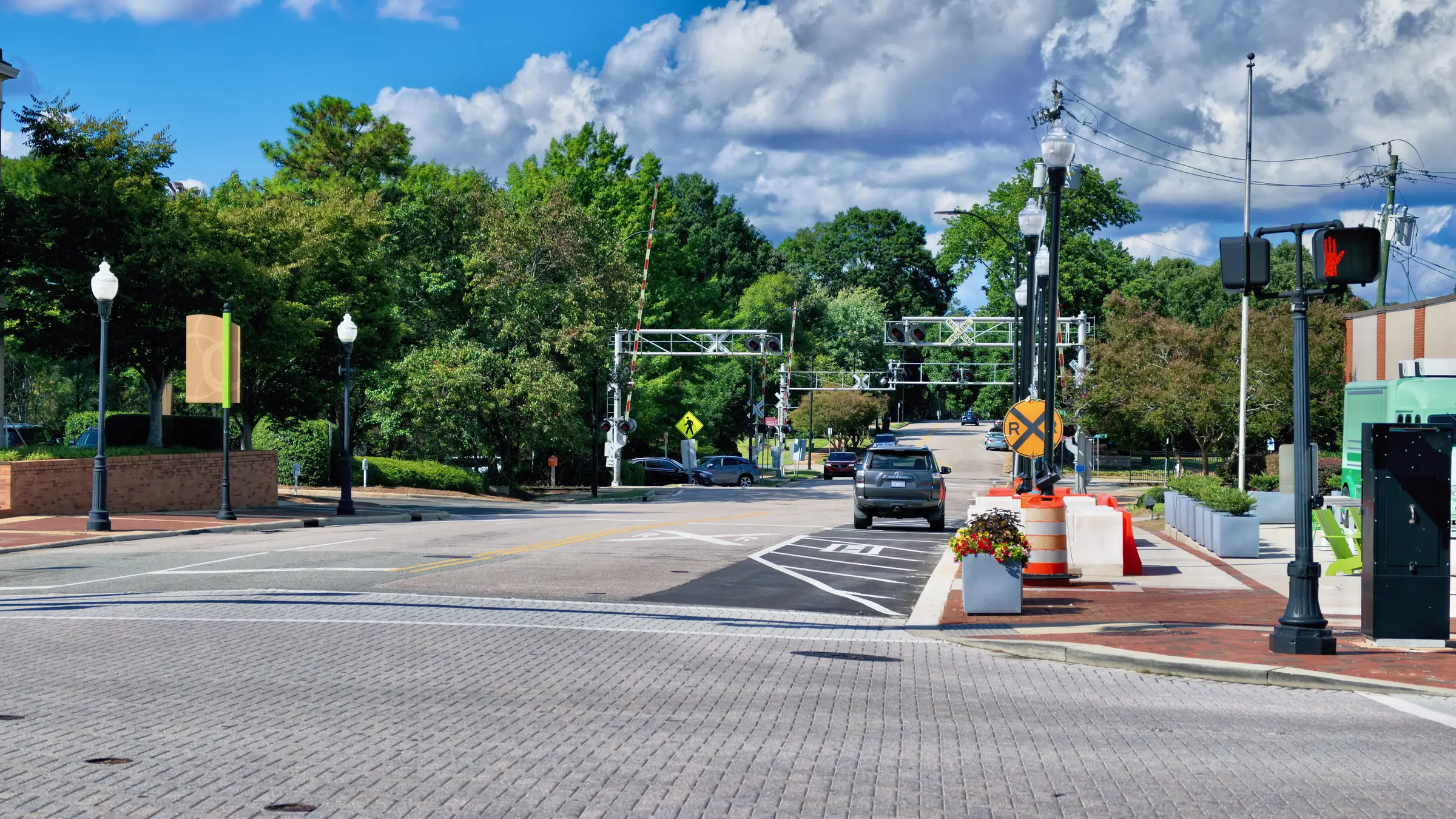
Academy Street, Chatham Street and the blocks around them. Cottages and bungalows from roughly 1900 to 1950, an arts center in the old high school, a park that opened in 2023, and a working Amtrak platform. The only walkable part of Cary. Read the study
- 04
East and south Cary
Kildaire Farm Road, Regency, Cary Parkway's southern arc. Mostly 1980s and 1990s, closer to Raleigh than to the Park, and generally the town's best value per square foot for buyers who do not need to be west.
 Placeholder image. FPO
What does a million dollars buy in Cary?
Very different houses depending on which of the four Carys you are in — and that is the useful answer, because the number itself moves. In west Cary it tends to buy newer and larger; in the golf belt, older and better-landscaped; downtown, smaller and walkable.
We do not publish a figure here that we have not sourced and dated. What we can say without qualification is that the same budget produces materially different houses across a fifteen-minute drive, and that the difference is structural rather than seasonal.
The neighborhood studies on this site are written to make that comparison concrete, and the market reports carry the numbers with their source attached.
Three other ways of cutting the same town: Cary’s ZIP codes, which do not line up with the town limits the way people assume; the 55+ communities, only some of which are actually age-restricted; and the top of the market, where no published threshold exists.
What the ordinances actually did
Cary's tree preservation and buffer requirements mean that when a subdivision goes in, a band of existing canopy usually stays at its edges. Thirty years of that produces a town where the arterials feel like corridors through woods rather than through retail.
The signage ordinance is the other visible one. Cary limits size, height, illumination and, in places, color. It is the reason national chains here look subdued compared with their signage two miles away in another jurisdiction, and the reason visitors regularly drive past a shopping center without registering it.
Architectural and materials standards do the rest. Large expanses of vinyl are constrained on prominent elevations; brick, stone and fiber cement dominate as a result. This is a genuine construction-quality benefit and it is also why so many Cary streets share a palette.
None of this is unique in principle — plenty of towns have design guidelines. What is unusual is the consistency and the length of time Cary has enforced them. The result compounds.
Getting your bearings
- Cary sits directly west of Raleigh, with Apex to its south-west, Morrisville to its north and Research Triangle Park just beyond that.
- The town is crossed east-to-west by US-64 and Chatham Street, and north-to-south by NC-55, Cary Parkway and Kildaire Farm Road. Cary Parkway is the ring: if you can hold its shape in your head, you can navigate the town.
- NC-540, the Triangle Expressway, runs along the town's western side and is tolled. It is the main reason west Cary commutes are shorter than the map implies.
- The Amtrak platform is downtown, on the Carolinian and Piedmont services toward Raleigh, Durham, Greensboro and Charlotte.
Cary's town limits are irregular and include areas most people would call Morrisville or Apex. Confirm jurisdiction on the parcel record — it decides your tax rate, your utilities and your inspections.
Current listings
Cary listings
Live inventory, filtered to the town limits and refreshed from the feed.
Ask for the current list
There is no live listing search on this site yet. Cary is four towns wearing one name, so a single town-wide feed would be the least useful way to look at it. Say which part of Cary, the price band and the property type.
- Start with place
- Cary neighborhoods — Preston, West Cary and Downtown Cary price and behave differently.
- Sourced figures
- Wake County market report — median sale price, days on market and sale-to-list ratio, with the period and the source stated.
No listing data is stored in this site.
Before you buy in Cary
- Is Cary expensive relative to the rest of the Triangle?
- It generally prices above Apex, Morrisville and Holly Springs for a comparable house, and below the strongest inside-the-Beltline Raleigh neighborhoods. The premium is real and is usually attributed to schools, ordinance-driven quality and location between Raleigh and the Park.
- Which part of Cary is closest to Research Triangle Park?
- The north-west — Carpenter, Highcroft and the Davis Drive corridor — is closest, typically ten to twenty minutes to a Park entrance. South and east Cary run longer and are better positioned for downtown Raleigh.
- Are there walkable parts of Cary?
- Downtown, around Academy and Chatham Streets, is genuinely walkable — park, library, arts center, restaurants and the rail platform within a few blocks. Elsewhere Cary is a driving town with an unusually good greenway network layered over it.
- What are the greenways like?
- Black Creek Greenway and White Oak Creek Greenway are the two spines, and they connect to Bond Park, Symphony Lake and onward into the wider Triangle network. Several neighborhoods have direct trail access from inside the subdivision, which is worth checking on foot before you buy.
- Is homeowners' association membership common?
- Very. Most Cary subdivisions built since the 1980s have an association, and the golf and lake communities have substantial ones. Read the covenants and the reserve study before you are under contract, not after.
More on Cary
- Schools
- How Wake County school assignment works, and what it means for a Cary address.
- Moving to Cary for Epic Games or Another Cary Employer: A Relocation Guide
- Cary’s major employers, and what living within reach of them is worth.
Already own in Cary and want the next house?
Moving up inside the same town is a different problem from moving here. It is mostly a sequencing problem, and there are more ways to solve it than most people are shown.
Neighborhood studies in Cary

Reporting on Cary
- Four days, sixty-one daysIt happens on ordinary streets in Cary and Raleigh every month: two comparable houses, listed weeks apart, with completely different outcomes. The explanation is almost never the market.Housing Data
- At the design centerThe design center appointment is presented as the fun part. It is also where a large amount of money moves from structure into finishes, and the two do not hold their value the same way.Development
- The paneled studyThere is a standard renovation happening across Cary's 1990s housing stock, and it is so consistent that you can predict a house's next five years from its floor plan.Architecture
- RTP without I-40I-40 between Wade Avenue and the Park is the single most reliable source of lost time in this region. There are four ways around it, and which one works depends on where you are coming from.Relocation
Practical questions before you buy in Cary
Cary is not one uniform housing market. A move to Cary works best when you choose the part of town around your actual commute, housing-age preference, school-assignment needs and daily routine—then verify the exact parcel’s county, municipal tax rate and public-school assignment.
Cary sits between Raleigh and Research Triangle Park, has more than 100 miles of greenways, a seven-acre Downtown Cary Park, fixed-route transit and town limits that extend across Wake, Chatham and Durham counties. Those facts make “Cary” a useful starting label, not the final address decision. Town of Cary, Greenways · Town of Cary, Taxes and Assessments
What should I decide before I start looking at Cary homes?
Decide the constraint that costs you time every week. For most relocating households it is one of these:
- commute to Research Triangle Park versus downtown Raleigh;
- newer construction versus an older established neighborhood;
- direct greenway access versus a larger lot or different street pattern;
- proximity to downtown Cary versus highway access;
- a particular school-assignment process or calendar need;
- ability to carry two homes if you are moving before your current house sells.
A house search gets much faster once one of these is ranked first.
Is all of Cary in Wake County?
No. Cary’s town limits span Wake, Chatham and Durham counties, although the Town notes that county government handles assessment, billing and collection based on the county where the parcel sits. Town of Cary, Taxes and Assessments
That matters because the county can affect:
- the county property-tax rate;
- public-school system;
- elections and county services;
- some records and permitting workflows.
Do not infer county from a Cary mailing address. Verify the parcel.
How are property taxes calculated in Cary?
For a Cary property in Wake County, the FY2027 Wake County rate and Cary municipal rate are both part of the basic property-tax calculation. Cary adopted a municipal rate of $0.3675 per $100 of assessed value for FY2027. Town of Cary, FY2027 Budget
Wake County’s FY2027 budget uses a county rate of $0.5371 per $100. The county’s official recommended budget set that rate, and the Board adopted the FY2027 budget on June 1, 2026 without changing the published 53.71-cent rate. Wake County FY2027 Recommended Budget
For a hypothetical $500,000 assessed Wake County Cary property, the basic county-plus-town calculation is:
- Wake County: $500,000 ÷ 100 × 0.5371 = $2,685.50
- Cary: $500,000 ÷ 100 × 0.3675 = $1,837.50
- Combined illustration: $4,523.00 per year
This is a calculation, not a tax quote. Special districts, exemptions, fees, assessment changes and a parcel outside Wake County can change the bill.
How does school assignment work in Cary?
For Cary addresses in Wake County, Wake County Public School System assigns a base school by exact residential address. WCPSS says every student has a base school and some schools are capped. WCPSS, Base Schools
Use the official lookup: WCPSS Assignment Lookup.
For a serious property, check:
- current base elementary, middle and high schools;
- calendar type;
- cap status;
- any proposed future reassignment;
- whether the family is relying on a choice/transfer rather than the base assignment.
Do not rely on school labels from a listing portal.
What is downtown Cary actually like?
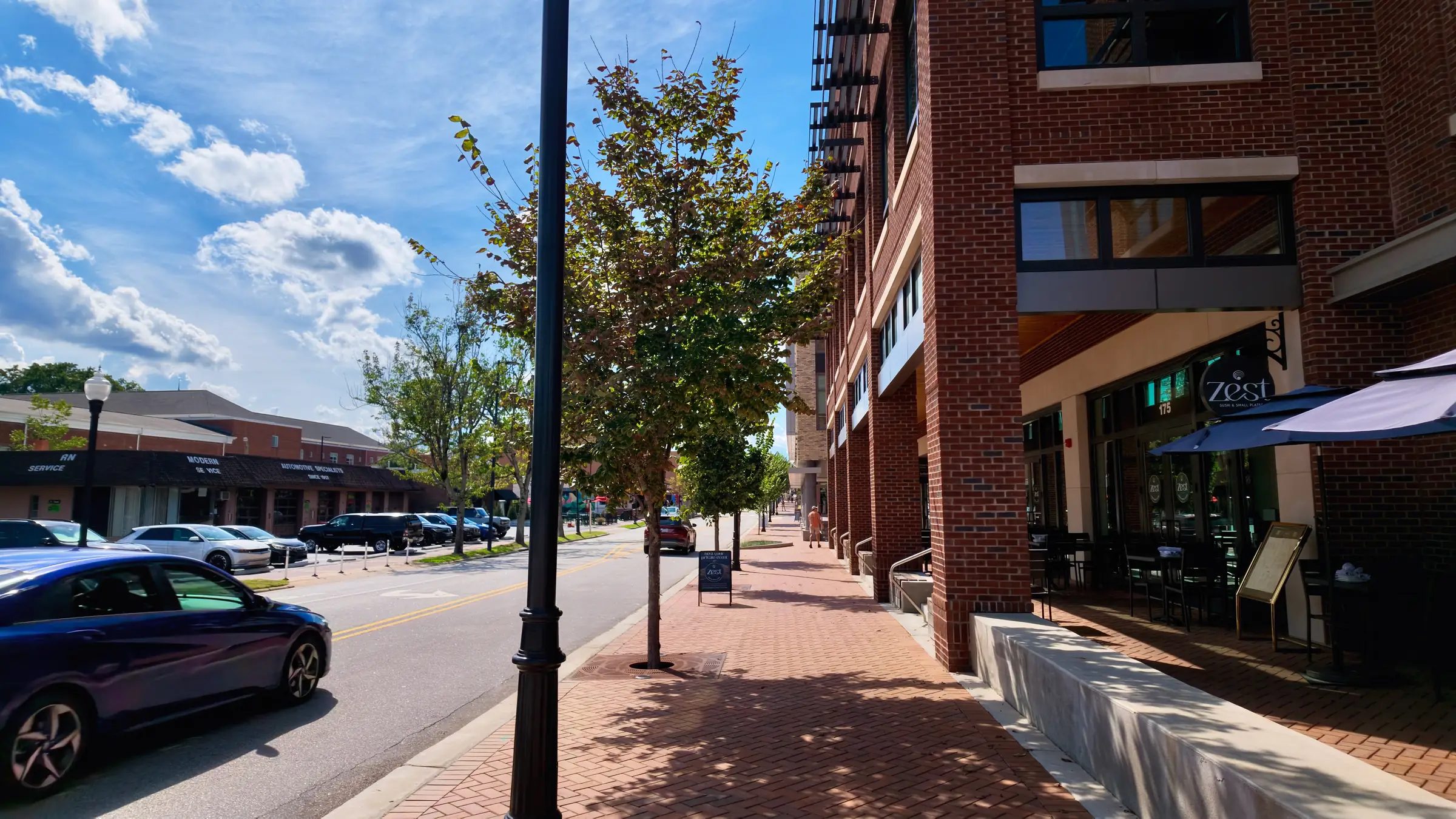
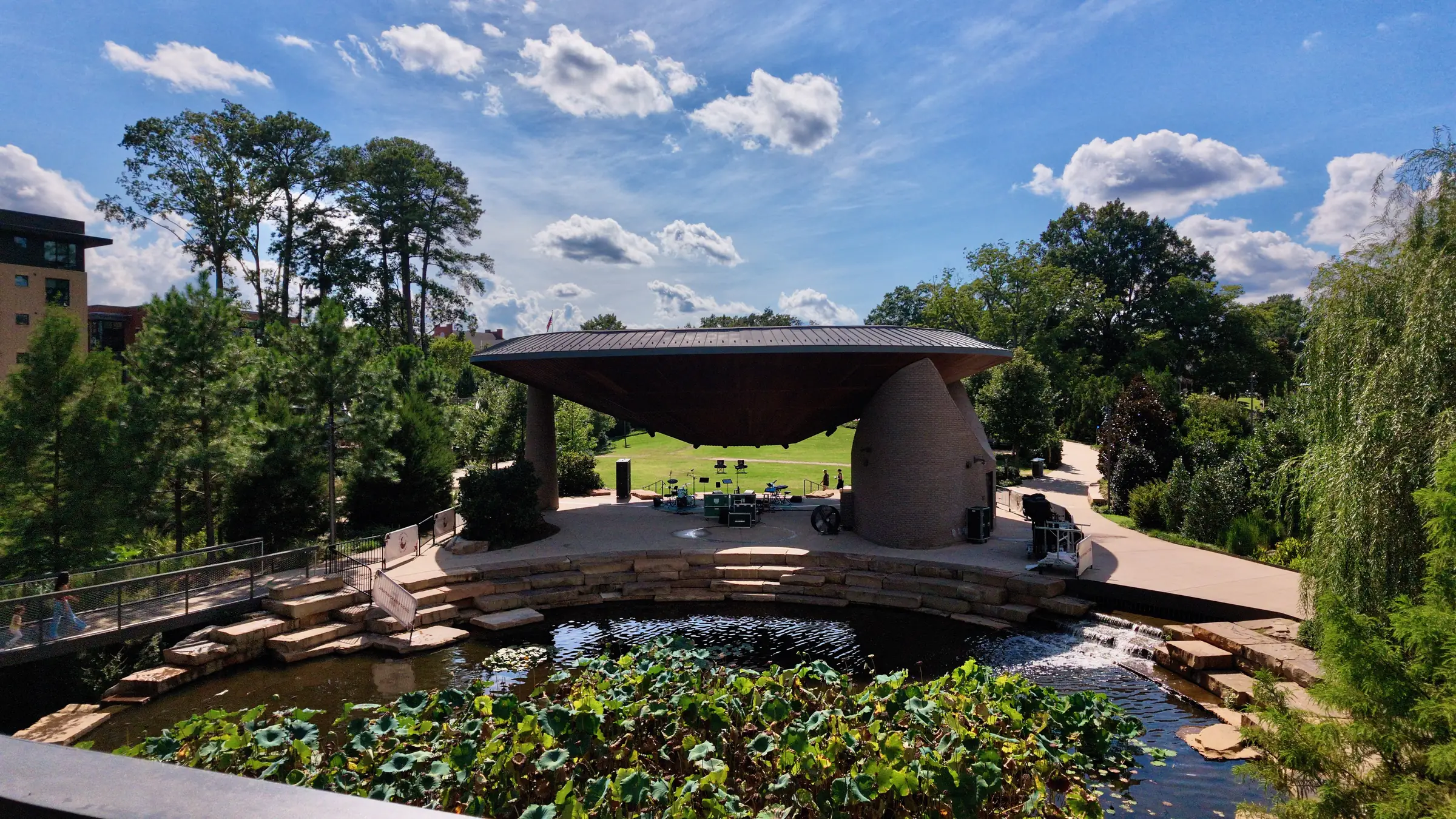
Downtown Cary is the town’s clearest walkable civic and entertainment core, centered around Academy and Chatham Streets and anchored by the seven-acre Downtown Cary Park. The Town says the park includes event space, public art, play areas, gardens, a dog area and other mixed-use public spaces. Town of Cary, Downtown Cary Park
If walkability matters, test it from the house, not from the town name. Much of Cary remains suburban and car-oriented even though downtown itself is compact.
How extensive are Cary’s greenways?
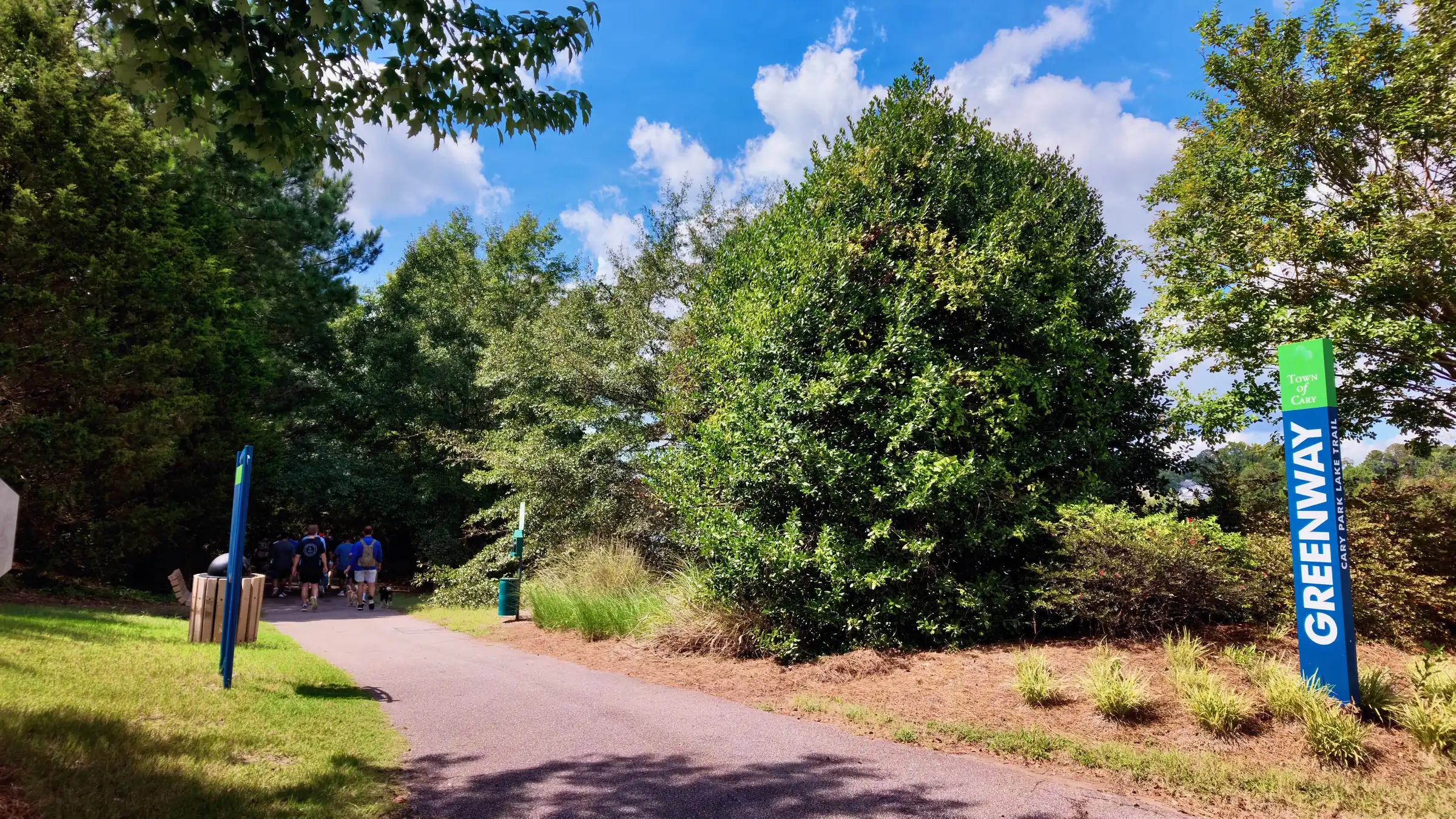
Cary reports more than 100 miles of paved greenway trails connecting parks, neighborhoods, schools, shopping centers and businesses. Black Creek and White Oak Creek are two major spines. Town of Cary, Greenways
The housing-search distinction is direct access versus nearby access. A trailhead inside or directly connected to a subdivision can become part of a daily routine; a trail a half-mile away across a major road may function more like a weekend destination.
Walk the route before you treat “greenway nearby” as a feature.
Is there public transit in Cary?
Yes. GoCary operates fixed-route and door-to-door transit and connects with regional providers. The current GoCary service information should be checked when transit is part of the move because routes and temporary service conditions can change. Town of Cary, GoCary
GoCary’s current service information indicates fixed-route and Tier 1 service are fare-free through June 30, 2027. GoCary, Fares & Passes
In July 2026, Cary suspended the Downtown Loop because of a driver shortage while other fixed routes continued to serve most downtown-loop stops—an example of why current route verification matters. Town of Cary, Downtown Loop suspension
What utilities and services should a new Cary resident set up?
The Town’s “New to Cary” guidance provides current setup links. Cary identifies Duke Energy for electric service and Enbridge Gas for natural gas service where applicable, while county-level services depend on the county in which the address sits. Town of Cary, New to Cary
Before closing, make a transfer list for:
- electricity;
- gas if present;
- municipal water/sewer account where applicable;
- trash/recycling;
- internet;
- HOA access and dues;
- alarm/smart-home systems;
- DMV and voter-registration updates after the move.
What North Carolina tax facts matter when relocating?
North Carolina’s individual income tax rate for tax years beginning after 2025 is 3.99%, subject to future statutory triggers. North Carolina Department of Revenue, Tax Rate Schedules
Wake County’s current general sales-and-use tax rate is 7.25% according to NCDOR’s county rate table. NCDOR, Current Sales and Use Tax Rates
These are broad tax facts, not individualized tax advice. A relocating household with multi-state income, equity compensation or a business should get tax advice specific to its move date and residency facts.
What should I test on a Cary scouting trip?
Do fewer showings and more real-life tests:
| Test | Why it matters |
|---|---|
| Drive to the actual workplace at the real departure time | Commute differences are route-specific |
| Walk from the property to the claimed greenway/park | Confirms whether access is truly usable |
| Visit the street after dark | Reveals lighting, traffic, parking and noise |
| Check the parcel’s county and town jurisdiction | Controls taxes/services/school system |
| Run the WCPSS address lookup | Replaces listing-school assumptions |
| Read HOA documents | Finds recurring cost and use restrictions |
| Inspect drainage/topography around the lot | Aerial maps and sunny showings miss water behavior |
A relocation trip that answers these questions is more valuable than one that tours twenty interchangeable houses.
How early should I plan a move to Cary?
Start with financing and sale/purchase sequencing before you fall in love with a listing. If you already own a home, your options may include selling first, arranging post-closing possession, buying first with available liquidity/equity, or using a custom contingency when appropriate.
The correct route depends on whether you can qualify while carrying both homes, how much liquid cash you need and how much timing risk you are willing to accept. See the Move Up NC guide to buying before selling.
The key takeaway
Moving to Cary is a submarket decision before it is a house decision. Verify the county, tax structure and school assignment for the exact property; test the commute and greenway access from the street; and decide whether downtown access, newer construction or proximity to RTP matters most before you start negotiating.
Cary’s strength is the number of different housing environments inside one town. The cost of that variety is that a town-wide label tells you less than you think.